Select Page

Pi Network First Crypto Miner for Mobile.

Pi Network introduce First crypto currency mining app to mobile platform, to join and download miner app please click below button and use invitation code " impiza ".

What makes Pi different ?

  • Mining crypto is hard.
  • Investing in crypto is risky.
  • Too many of us are left out of the cryptocurrency revolution.
  • Pi makes crypto mining easy
  • Breakthrough tech allows you to mine on your phone without draining your battery.
Decentralized

Secure, Immutable, non-counterfeitable and interoperable digital money.

Mobile First

Works on your mobile phone and does not drain your battery.

User & Planet-Friendly

Easy to use security at scale, without the massive electrical waste.

use above link, it will guide you to Pi network official website.

Currently Pi not yet listed on exchanges and you can't buy it with any currency, the only way to install pi app and start working using invitation code.


Do not download any apps outside Pi network

by clicking download button, it will redirect you to official android play store, install the app. 
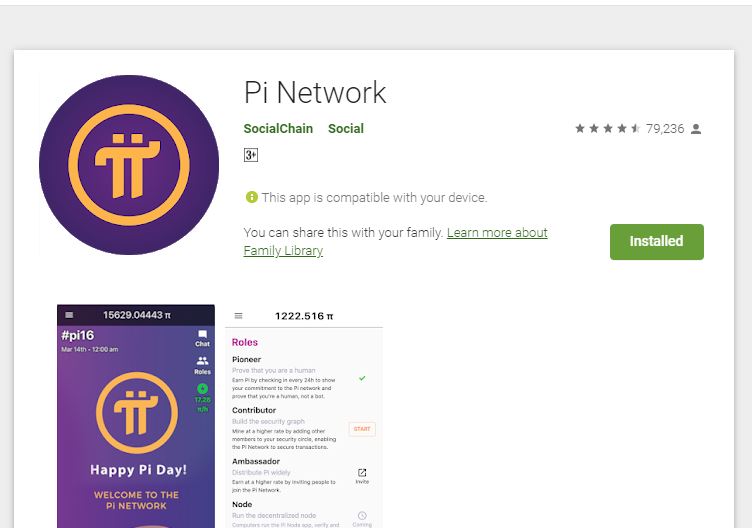
Open your application, now type "Your desired username", remember if you invite your friends in the future you have to use this as your invitation code,

 there are 2 types of verification available

  1. Facebook
  2. Phone Number

you have to choose one of those, this will help you to retrieve your pi miner if you phone is lost.

Remember "Yon only use one device at a time"


Finally use invitation code " impiza ", now you can start mining, you need to open miner at least once every day.  by doing so you can also verify your team members are mining or not, if they are not mining you can ping them and notify.

 

Introduction: Why cryptocurrencies matter

Currently, our everyday financial transactions rely upon a trusted third party to maintain a record of transactions. For example, when you do a bank transaction, the banking system keeps a record & guarantees that the transaction is safe & reliable. Likewise, when Cindy transfers $5 to Steve using PayPal, PayPal maintains a central record of $5 dollars debited from Cindy’s account and $5 credited to Steve’s. Intermediaries like banks, PayPal, and other members of the current economic system play an important role in regulating the world’s financial transactions.


However, the role of these trusted intermediaries also has limitations:


  1. Unfair value capture. These intermediaries amass billions of dollars in wealth creation (PayPal market cap is ~$130B), but pass virtually nothing onto their customers - the everyday people on the ground, whose money drives a meaningful proportion of the global economy. More and more people are falling behind.
  2. Fees. Banks and companies charge large fees for facilitating transactions. These fees often disproportionately impact lower-income populations who have the fewest alternatives.
  3. Censorship. If a particular trusted intermediary decides that you should not be able to move your money, it can place restrictions on the movement of your money.
  4. Permissioned. The trusted intermediary serves as a gatekeeper who can arbitrarily prevent anybody from being part of the network.
  5. Pseudonymous. At a time when the issue of privacy is gaining greater urgency, these powerful gatekeepers can accidentally disclose -- or force you to disclose -- more financial information about yourself than you may want.

Solution: Pi - Enabling mining on mobile phones

After identifying these key barriers to adoption, the Pi Core Team set out to find a way that would allow everyday people to mine (or earn cryptocurrency rewards for validating transactions on a distributed record of transactions). As a refresher, one of the major challenges that arises with maintaining a distributed record of transactions is ensuring that updates to this open record are not fraudulent. While Bitcoin’s process for updating its record is proven (burning energy / money to prove trustworthiness), it is not very user (or planet!) friendly. For Pi, we introduced the additional design requirement of employing a consensus algorithm that would also be extremely user friendly and ideally enable mining on personal computers and mobile phones.

Roadmap / Deployment plan

Phase 1 - Design, Distribution, Trust Graph Bootstrap.

The Pi server is operating as a faucet emulating the behavior of the decentralized system as it will function once its live. During this phase improvements in the user experience and behavior are possible and relatively easy to make compared to the stable phase of the main net. All minting of coins to users will be migrated to the live net once it launches. In other words, the livenet will pre-mint in its genesis block all account holder balances generated during Phase 1, and continue operating just like the current system but fully decentralized. Pi is not listed on exchanges during this phase and it is impossible to “buy” Pi with any other currency.

Phase 2 - Testnet

Before we launch the main net, the Node software will be deployed on a test net. The test net will use the same exact trust graph as the main net but on a testing Pi coin. Pi core team will host several nodes on the test net, but will encourage more Pioneers to start their own nodes on the testnet. In fact, in order for any node to join the main net, they are advised to begin on the testnet. The test net will be run in parallel to the Pi emulator in phase one, and periodically, e.g. daily, the results from both systems will be compared to catch the gaps and misses of the test net, which will allow Pi developers to propose and implement fixes. After a thorough concurrent run of both systems, testnet will reach a state where its results consistently match the emulator’s. At that time when the community feels its ready, Pi will migrate to the next phase.

Phase 3 - Mainnet

When the community feels the software is ready for production, and it has been thoroughly tested on the testnet, the official mainnet of the Pi network will be launched. An important detail is that, in the transition into the mainnet, only accounts validated to belong to distinct real individuals will be honored. After this point, the faucet and Pi network emulator of Phase 1 will be shut down and the system will continue on its own forever. Future updates to the protocol will be contributed by the Pi developer community and Pi’s core team, and will be proposed by the committee. Their implementation and deployment will depend on nodes updating the mining software just like any other blockchains. No central authority will be controlling the currency and it will be fully decentralized. Balances of fake users or duplicate users will be discarded. This is the phase when Pi can be connected to exchanges and be exchanged for other currencies.

Types of Pi Users

  • Pioneer. A user of the Pi mobile app who is simply confirming that they are not a “robot” on a daily basis. This user validates their presence every time they sign in to the app. They can also open the app to request transactions (e.g. make a payment in Pi to another Pioneer)
  • Contributor. A user of the Pi mobile app who is contributing by providing a list of pioneers he or she knows and trusts. In aggregate, Pi contributors will build a global trust graph.
  • Ambassador. A user of the Pi mobile app who is introducing other users into Pi network.
  • Node. A user who is a pioneer, a contributor using the Pi mobile app, and is also running the Pi node software on their desktop or laptop computer. The Pi node software is the software that runs the core SCP algorithm, taking into account the trust graph information provided by the Contributors.

I will include mining using node in the future blog.

Happy Mining

BLOCKCHAINS

Blockchains are incredibly popular now a days.
What is a block chain how do they work what problems do they solve and how can they be used.


Like the name indicates a blockchain is a chain of blocks that contain information, this technique was originally described in 1991 by a group of researchers and was originally intended to time stamp digital documents so it’s not possible to backdate them or to tamper with them,almost like a notary.

However it went by mostly unused until it adapted by Satoshi Nakamoto in 2009 to created a digital crypto currency called bitcoin.

Now a blockchain is distributed ledger that is completely open to anyone they having interesting property, once a data has been recorded inside a blockchain it becomes very difficult to change it.

So how does that works!!!

Well take a closer look at a block. Each block contains some data, the hash of the block and the hash of the previous block.


The data that is stored inside the blocks defines the type of blockchain, the Bitcoin blockchain for example solves the details of the transactions such as the sender, the receiver and the amount of coins.
A block also has a hash, you can compare the hash to a fingerprint it identifies a block and all it’s contents and it is always unique just as a finger print.

Once the block is created it’s hash is being calculated. Changing something inside the block cause the hash to change, to another words hashes are very useful when you want to detect the changes to the block. If the fingerprint of the block changes it’s no longer the same block.

The third element inside of each block is the hash of the previous block and this effectively creates a chain of block and it’s the technique that makes the blockchain so secure.


Here we have a chain of three blocks and each block has an hash of the block and the hash of the previous block.
The block number three points to the block number two and the number two points to number one.
Now the first block is little bit special, it cannot points to it’s previous block, because it is the first block we call this block the Genesis block.

Now let’s say if we tamper with the second block, this causes the hash of the block to be changed as well, in turn that will make block 3 and all following blocks invalid, because they no longer store a valid hash of the previous block.
So changing a single block will make all following blocks invalid.

But using a hash is not enough to prevent tampering. Computers these days are faster and calculate hundred of thousands of hashes per second, you can effectively tamper with the block and recalculate all the hashes of other block to make the blockchain valid again.


Proof of Work


So to mitigate this blockchain has something called proof of work. it’s a mechanism that slows down the creation of a new block.

In bitcoins case it take about 10 minutes to calculate the required proof of work and add a new block to the chain, this mechanism makes it very hard to tamper with one block you need to recalculate the proof of work of all the following block.

So the security of the blockchain comes from creative use of hashing and the proof of work mechanism, but there is one more way that the block chain secured themselves and that is by being distributed. Instead of using a central entity to manage chains, blockchains use a peer to peer network and every one is allowed to join.

When someone joins this network he gets a full copy of the blockchain the node can use this to verify that everything is in order.

Now lets see what happens if some one creates a new block, that the block is sent to everyone on the network, each node then verify the blocks to make sure that the block is not tamper with and if everything checks out each node add the block to their own blockchain. All the nodes in this network creates consensus, the agree about what blocks are valid and which aren’t.

Blocks that are tampered with will be rejected by the other nodes in the network. So to successfully tamper with a blockchain, you need to tamper with all the blocks on the chain, redo the proof of work for each block and take control of more than 50% of the peer to peer network.
Only then when your tampered block becomes accepted by everyone else, so this is almost impossible to do.


Blockchains are also constantly evolving and one of the most recent development is the creation of smart contract.

The contracts are simple programs that are stored on the blockchain and it can be used to automatically exchange coins based on certain conditions.

The creation of blockchain technology peek the lot of peoples interest. Soon others realize that the technology can be used for other things likes

> Storing medical records.
>> Creating digital notary.
>> Collecting taxes.


So now you know what a blockchain is how it works on a basic level and what problems they solve.


How to access your Linux Desktop using android app

How to access your Linux Desktop using android app 

To using this you need to be in same network


There are two apps available in playstore free and pay 

for this tutorial i have used free one

install this app and open it in your android device

then configured it with ip , username and password of your linux machine


Click connect to establish connection between your linux machine and Android device 


enjoy 🙂

How to find best mobile or wifi hotspot coverage using your Android Device

Using this free app you can find coverage in your place for all kind of network 2g , 3g , 4g it support all kind of providers , which give access to users to locate best coverage nearby , app also provide a list and colored real time map 
OpenSignal also helps to locate nearby hostspots it also can measure signal strength, This is some thing really cool feature i have found on play store , this is a must have app in your android device  


How to remove older Android Devices from Google Play

Remove older Android Devices from Google Play

As you can see above you can find a list of older devices i have used in the past 
its very easy to remove those devices from the list 
all you need to do is click on the settings icon on the right corner of the google play page 
then select > Settings

This will redirect to setting page there you can find your list of older devices 
Now you can see your devices 

simply uncheck old devices and also update your New Device Nickname and click update , then reload the page and see its changes ! go to your play store page to confirm !
Ta da , you can see now only new device is showing , also updated device Nickname

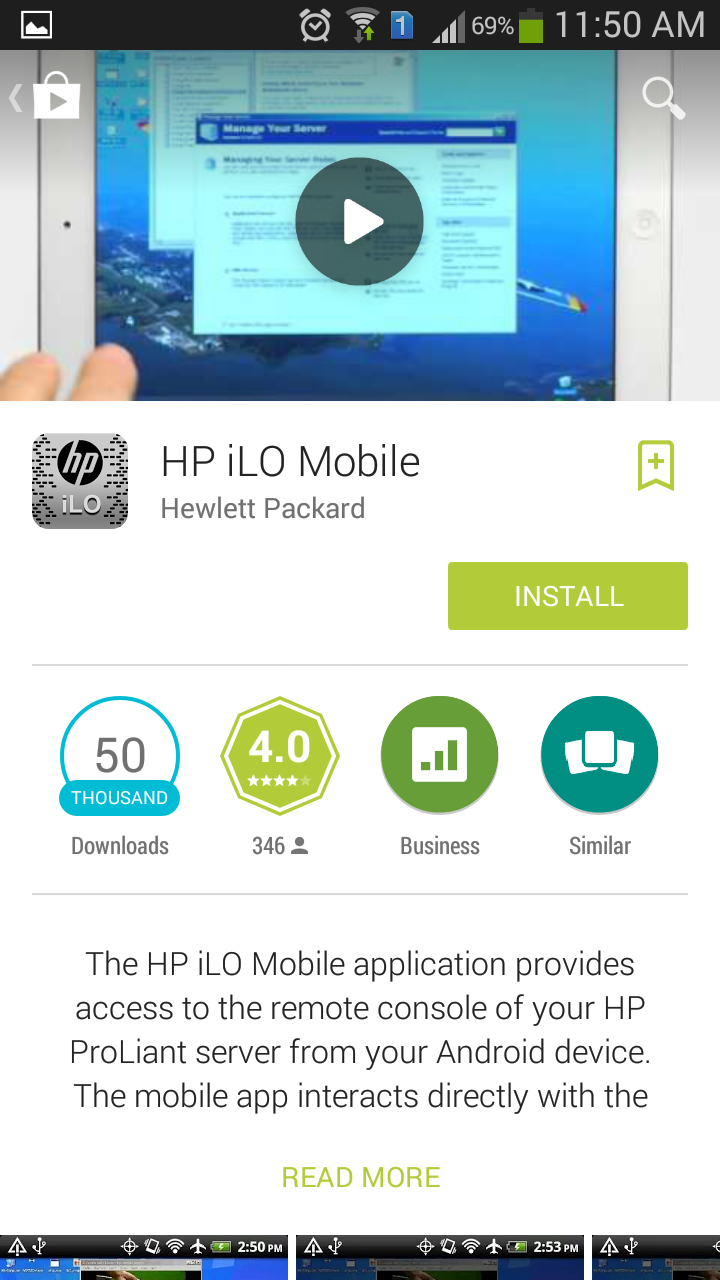
How to Install & configure iLO, HP Integrated Lights Out (iLO) on Android

go to Google play and search HP iLO or here is the link to Google Play 

Supported servers

  • HP ProLiant Gen8 Servers
  • HP ProLiant G7 Servers

Supported mobile operating systems

  • Android 2.2 or greater
  • iOS 4.3 or greater

Manage

  • Operate the server power switch
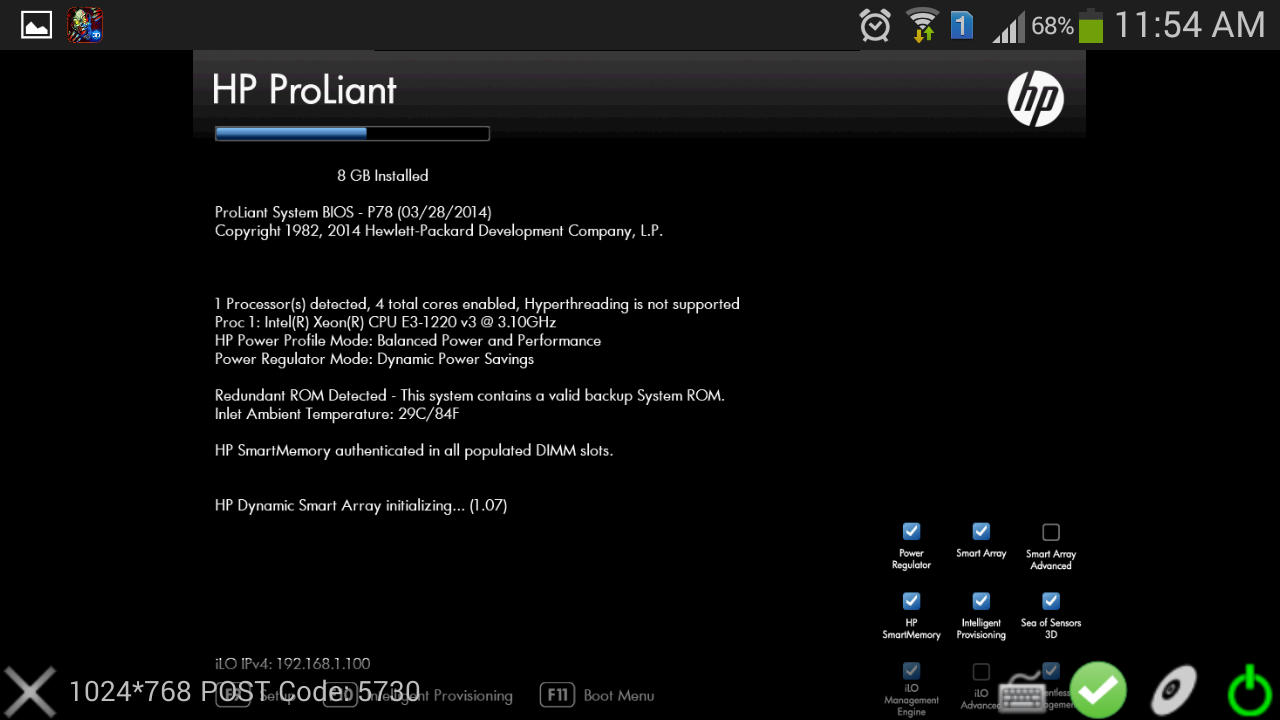
  • Use the Remote Console to interact with the operating system, including BIOS and ROM configuration changes
  • Mount an ISO CD/DVD image. The disk image is available on the server as a USB CD/DVD drive. You can boot from the disk image and deploy an operating system
  • Launch HP iLO scripts and monitor their progress
  • Access the iLO web interface
  • Store the list of servers you want to manage
install it and launch it 


after launching the application click 
configure iLO option
add assigned ip for iLO 
Login name and password


click done after adding the details 
click the iLO ip 
you will get 3 options 
  1. Remote Console
  2. Lauch Script
  3. iLO Web Interface
click Remote Console
 for using iLO


Quick tips

  • Show/Hide menu bar – Tap once with two fingers to show or hide the menu bar in the Remote Console
  • Show/Hide iLO web interface – Tap the server health icon in the Remote Console to show or hide the iLO web interface
  • Ctrl/Alt/Del Command – Tap Ctrl+Alt+backspace to enter the Ctrl+Alt+Del command

Pin It on Pinterest