
What is RAID 5
f
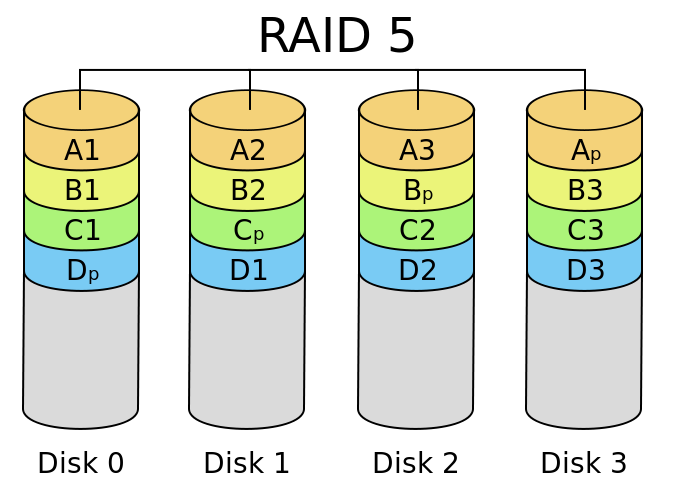
A RAID 5 comprises block-level striping with distributed parity. Unlike in RAID 4, parity information is distributed among the drives. It requires that all drives but one be present to operate. Upon failure of a single drive, subsequent reads can be calculated from the distributed parity such that no data is lost. RAID 5 requires at least three disks.
In comparison to RAID 4, RAID 5’s distributed parity evens out the stress of a dedicated parity disk among all RAID members. Additionally, read performance is increased since all RAID members participate in serving of the read requests.
HOT SPARE
A hot spare disk is a disk or group of disks used to automatically or manually, depending upon the hot spare policy, replace a failing or failed disk in a RAID configuration.The hot spare disk reduces the mean time to recovery (MTTR) for the RAID redundancy group, thus reducing the probability of a second disk failure and the resultant data loss that would occur in any singly redundant RAID (e.g., RAID-1, RAID-5, RAID-10). Typically, a hot spare is available to replace a number of different disks and systems employing a hot spare normally require a redundant group to allow time for the data to be generated onto the spare disk. During this time the system is exposed to data loss due to a subsequent failure, and therefore the automatic switching to a spare disk reduces the time of exposure to that risk compared to manual discovery and implementation.
The concept of hot spares is not limited to hardware, but also software systems can be held in a state of readiness, for example a database server may have a software copy on hot standby, possibly even on the same machine to cope with the various factors that make a database unreliable, such as the impact of disc failure, poorly written queries or database software errors.





0 Comments